Quick Answer: Mahr is a mandatory gift given by the Muslim groom directly to the bride during Nikah. It is her exclusive right and can be cash, gold, property, or another valuable asset. The amount is mutually agreed upon, should be affordable, and may be paid immediately or deferred.
As a Muslim couple plans their Nikah ceremony, the issue of Mahr, which is often talked about in whispers at family meetings or sometimes even openly, becomes one of the most significant issues to be discussed by them. While some families take it as a matter of formalism, there are others who take Mahr very seriously. Yet very few Muslims really understand Mahr and its significance in Islam.
If you are preparing for a Nikah, helping a son or daughter get married, or simply want to understand this beautiful aspect of Islamic marriage - this guide is for you. Whether you are searching for the right match through a trusted Muslim Marriage Bureau in Bangalore or already in the process of finalizing your Nikah, understanding Mahr is something every Muslim family should know. Let’s get started!
Mahr - also written as Mehr or Mehar - is the mandatory gift or financial obligation that a Muslim groom gives directly to his bride at the time of Nikah. It is not given to her parents. It is not given to her family. It belongs entirely and exclusively to the bride alone.
The meaning of Mahr in Islam is the bridal gift or obligation paid by the groom to the bride at the time of marriage. It symbolizes the husband's responsibility and sincerity in entering the marital bond.
In simple words - Mahr is the groom's first act of honouring his wife. It is a recognition of her rights, her dignity, and her place in the marriage.
Ahmed and Fatima are getting married in Bangalore. Before signing the Nikah contract, Ahmed agrees to give Fatima a Mahr of ₹1,00,000 in gold jewellery - half at the time of Nikah and the remaining half within one year. This amount is Fatima's right alone. She can spend it, save it, or invest it however she chooses. No one else has a claim on it.
⦿ Mahr is a mandatory right of the bride - not optional, not symbolic
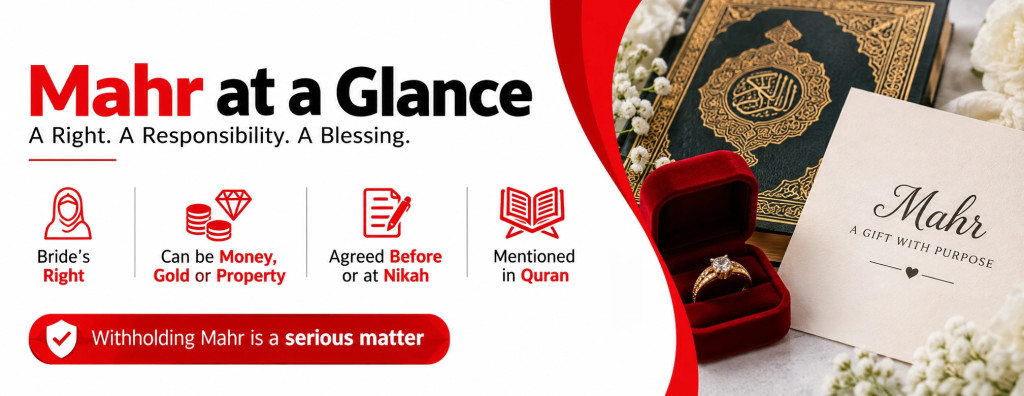
⦿ It belongs only to the bride - not her parents or family
⦿ It can be money, gold, property, or anything of value
⦿ It must be agreed upon before or at the time of Nikah
⦿ It is mentioned directly in the Quran - Surah An-Nisa 4:4
⦿ The marriage is still valid even if Mahr is not specified - but the obligation to pay remains
⦿ The wife can waive it voluntarily - but no one can pressure her to do so
⦿ Withholding Mahr is a serious matter - it is treated in Islamic law as a debt owed to the wife, and unlike many debts, it does not lapse
Mahr is not a cultural tradition. It is not a social custom. It is a direct command from Allah in the Holy Quran.
As said by Allah - "And give the women on marriage their Mahr as a free gift." (Quran 4:4). Mahr is the main aspect of Nikah and it is mandatory for the groom to give it to the bride.
Allah terms Mahr in the Quran as ujoor - its singular word being ajr - which means compensation, recompense or reward. It is essential to have Mahr in a marriage.
Beyond the religious obligation, Mahr carries deep practical meaning for the bride:
⦿ It protects the dignity and independence of the woman and acts as financial protection in case of divorce or the husband's death.
⦿ It represents the husband's commitment to providing for his wife - a tangible symbol of his responsibility and care for her.
⦿ It gives the wife financial independence from day one of the marriage.
⦿ It secures her rights and acts as a form of security and guarantee of freedom within the marriage, even if the marriage breaks down.
In Muslim communities across India - including families who connect through Best Muslim Marriage services in Bangalore - understanding Mahr as a right and not just a ritual is what sets a marriage on the right foundation.
Islam gives the liberty to a woman to choose her Mahr amount. The bride has every right to state what she wants as her Mahr. The groom and his family cannot force her to accept a lower amount.
In practice, the Mahr amount is decided through a mutual conversation between the bride and groom - or between their families and guardians (Wali) - before the Nikah contract is signed.
Factors that are commonly considered include:
⦿ The groom's financial capacity - Mahr should be within his means
⦿ Local customs and what is common in the community
⦿ What other women of similar family background and status have received
⦿ Whether the Mahr will be paid fully at the time of Nikah or partly deferred
⦿ The form of Mahr - cash, gold, property, or a combination
If there is dispute about the amount, scholars use the standard of what women of similar background and status typically receive - this is called Mahr al-Mithl.
In this case, a scholar or Islamic judge may be consulted to determine a fair and appropriate amount. The key principle is that the bride's right to Mahr is never cancelled - even if no amount was discussed during the Nikah.
⦿ Do not make Mahr a burden - Islam encourages a Mahr that is meaningful but not impossible to pay
⦿ Be honest about financial capacity - a modest Mahr paid sincerely is better than a large amount that remains unpaid
⦿ Put it in writing - record the agreed Mahr clearly in the Nikah Nama (marriage contract)
⦿ Do not let family pressure override the bride's right - the decision ultimately rests with the bride and groom
⦿ Discuss openly before the Nikah - clarity avoids conflict later
There is no minimum or maximum limit specified in the Shariah for Mahr. Whatever amount is mutually agreed upon by both parties - whether small or large - is valid and permissible. The Hanafi school places the minimum at ten dirhams of silver - roughly ₹7,000 at current rates - while the Shafi'i and Hanbali schools accept any mutually agreed item of value, even an iron ring. The Prophet himself gave his wives a Mahr of 500 dirhams. And when Ali (RA) had nothing to offer Fatima (RA), the Prophet accepted his shield as Mahr. This shows that sincerity and genuine worth matter far more than the size of the amount.
While Mahr is the wife's right, Islam does not demand that a man burden himself financially to pay it. The Prophet said - "The best of Mahrs is the one that is most affordable." A Mahr so high that the husband enters marriage carrying debt runs directly against this principle. For Muslim families across Bangalore and India - the wisest approach is to agree on a Mahr that genuinely honours the bride, is within the groom's means, and is paid with full sincerity - not treated as a mere formality on the day of Nikah.
Mahr does not have to be cash. Islam allows great flexibility in what can be given as Mahr - as long as it has genuine value.
Acceptable forms of Mahr include:
⦿ Cash - the most common form in India
⦿ Gold or jewellery - extremely common in South Indian Muslim families
⦿ Property or land - a house, plot, or real estate
⦿ Silver - traditional in some communities
⦿ Any valuable asset - agreed upon by both parties
The Prophet even approved a marriage where the Mahr was the husband's knowledge of the Quran. He said: "Go, I have agreed to marry her to you for what you know of the Qur'an as her Mahr." (Sahih al-Bukhari 5135)
This shows that Islam values sincerity and genuine worth over a specific form. What matters is that the Mahr holds real value and is given with a willing and honest heart.
Mahr in Islam is categorized in two ways - by how the amount is determined and by when it is paid. Understanding both helps couples and families make the right decision before the Nikah.
⦿ Mahr al-Musamma - the specific amount mutually agreed upon by both bride and groom during the Nikah contract. This is the most common and preferred type.
⦿ Mahr al-Mithl - a fair and standard Mahr that applies when no amount was specified during the Nikah. It is based on what women of similar family background and social standing typically receive.
⦿ Mahr Muajjal - paid immediately at the time of Nikah or shortly after.
⦿ Mahr Muakkhar - deferred to a later agreed date, upon divorce or upon the husband's death.
Both types are equally binding obligations on the husband and cannot be ignored under any circumstance.
Important Note: Many couples in India choose a combination - paying part of the Mahr as Muajjal on the day of Nikah and deferring the remaining portion as Muakkhar to a later agreed date. Both portions are equally binding and must be honoured with full sincerity.
Mahr and dowry are completely different. They are not the same. Here is a clear breakdown of the difference:
| Factor | Mahr | Dowry |
|---|---|---|
|
Who gives it |
Groom gives to bride |
Bride's family gives to groom's family |
|
Is it Islamic? |
Yes - commanded in Quran |
No - cultural practice, not Islamic |
|
Who receives it |
Bride alone |
Groom or groom's family |
|
Is it mandatory? |
Yes - legally binding |
No - social pressure, not law |
|
Legal status in India |
Protected under Muslim Personal Law |
Illegal under Dowry Prohibition Act 1961 |
|
Purpose |
Protects and honours the bride |
Transfer of wealth - often exploitative |
Mahr is not a formality. It is not a number written on a piece of paper just to complete the Nikah. It is a divine right given by Allah to every Muslim bride - a right that reflects her dignity, her worth, and her security in marriage. Whether large or small, paid immediately or deferred - what matters most is that Mahr is given with sincerity, honesty, and a genuine intention to honour the woman you are marrying. Every Muslim family must understand this before the Nikah - not after.
As Muslim families across Bangalore and India navigate the beautiful journey of finding the right life partner, understanding Mahr is one of the most important steps toward building a marriage on a strong Islamic foundation. At Best Muslim Marriage, the most trusted Muslim marriage bureau in Bangalore, we believe every Nikah begins with the right values. Take the first step toward a blessed Nikah with us.
Q1. Is Mahr compulsory in Islam?
Yes - Mahr is absolutely compulsory in Islam. It is commanded directly in the Quran in Surah An-Nisa 4:4. Even if Mahr is not specified during the Nikah, the obligation to pay it does not disappear. The husband is still required to pay a fair amount known as Mahr al-Mithl - based on what women of similar background and status typically receive.
Q2. Can the bride refuse to accept a low Mahr?
Yes. The bride has every right to state the Mahr she wants and to refuse an amount she feels does not reflect her worth. Islam gives the bride full liberty in deciding her Mahr. No one - not the groom, not his family, not her own family - can force her to accept an amount she is not comfortable with.
Q3. What happens to Mahr if the husband divorces the wife?
If divorce happens after the marriage has been consummated, the wife keeps her full Mahr. If the deferred portion has not yet been paid, it immediately becomes due upon divorce. The Mahr belongs to the wife and cannot be taken back by the husband except if she willingly and freely chooses to return it.
Q4. Is it permissible to give a very small Mahr in Islam?
Yes - Islam does not set a fixed minimum. Even a small amount is valid as long as it has genuine value and is agreed upon by both parties. The Prophet himself said that even a ring of iron is acceptable as Mahr. What matters most is sincerity and the genuine intention to honour the wife.
Q5. What if the husband dies before paying the deferred Mahr?
The deferred Mahr does not disappear if the husband passes away. It is treated as a debt on the husband's estate and must be paid to the wife before the inheritance is distributed among other heirs. The wife's right to her Mahr is protected even after the husband's death.