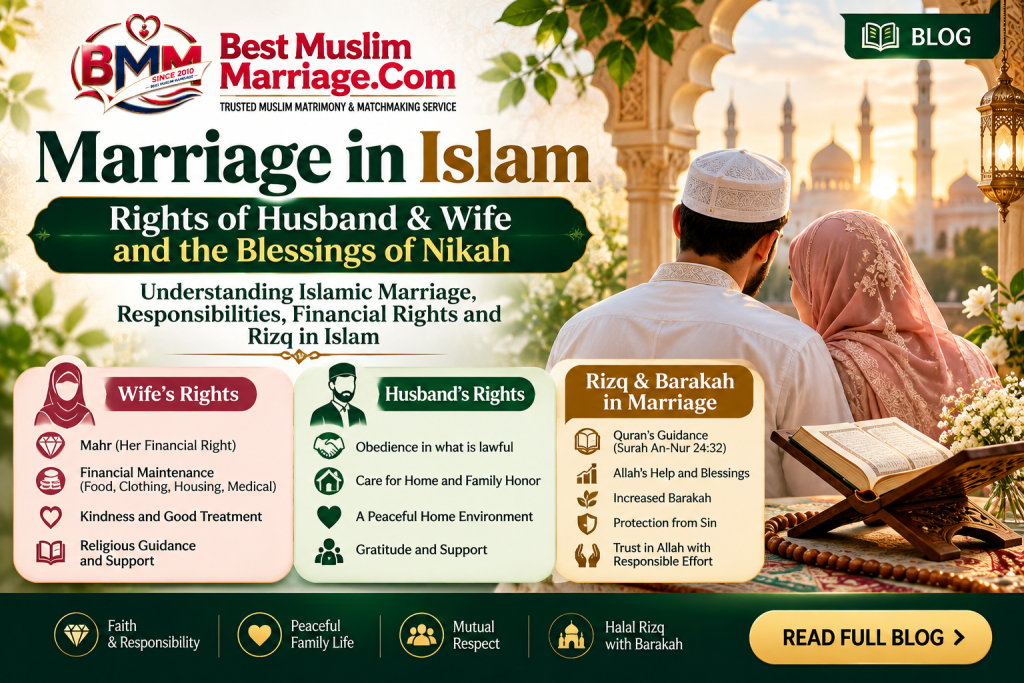
Marriage in Islam is not simply a social relationship or a wedding ceremony. Nikah is a meaningful commitment based on mutual rights, responsibilities, compassion, trust, respect and family values.
Islam gives both husband and wife important rights and responsibilities. At the same time, Islam encourages Muslims not to let fear of financial difficulty become the only reason for avoiding marriage when they are otherwise ready and able to fulfil its responsibilities.
In this guide, we will explore two important questions: What are the rights of a husband and wife in Islam, and what does Islam teach about marriage, Rizq and financial blessings?
Islam establishes a framework of rights and responsibilities between spouses. These rights are not intended to create competition between husband and wife. Rather, they are meant to encourage justice, cooperation, kindness and a stable family life.
The husband has important responsibilities towards his wife. These include financial responsibilities as well as good treatment, respect and protection of her rights.
Mahr is a financial gift agreed upon as part of the Nikah and belongs to the wife. It is her personal right and should be given according to the agreed terms.
The Mahr should not be treated as a payment for the marriage. It is a right granted to the wife within the Islamic marriage contract.
Islam places financial responsibilities upon the husband according to his means and circumstances. Traditionally, these include providing suitable food, clothing and accommodation for his wife and family.
The exact details of financial maintenance can depend on circumstances and Islamic jurisprudence. The important principle is that a husband should responsibly fulfil the financial rights of his wife and family rather than neglecting them.
Good character is one of the foundations of a healthy Muslim marriage. A husband should treat his wife with kindness, dignity, patience and respect.
The Prophet Muhammad ﷺ emphasized good treatment of one's family. A successful Muslim marriage should therefore not be built only around financial provision but also around mercy, communication, emotional support and respectful behaviour.
Marriage can become a means of helping one another grow in faith and character. Husband and wife should encourage each other towards good deeds, responsible behaviour and a peaceful family environment.
This does not mean that one spouse has the right to control or mistreat the other. Religious guidance within marriage should be based on wisdom, mutual respect and the principles of Islam.
The wife also has responsibilities within marriage. These responsibilities should be understood alongside her rights, dignity and personal circumstances.
A healthy marriage requires cooperation. Both spouses should work together to maintain trust, respect and stability within the household.
Islamic teachings regarding a wife's obedience to her husband are understood within the limits of what is lawful and reasonable. Obedience does not mean obeying a command to commit a sin, tolerate abuse or violate Islamic principles.
Marriage involves a significant level of trust. Husband and wife should protect each other's privacy, dignity and confidential matters.
Both spouses should also take reasonable care of family responsibilities and avoid behaviour that damages the trust and reputation of the household.
A peaceful home is created by both spouses. Kind communication, patience, appreciation and emotional support can make a major difference in married life.
A wife should not be expected to carry every household responsibility alone, just as a husband should not be expected to carry every emotional or family responsibility alone. A successful marriage requires cooperation and understanding.
Appreciating each other's efforts is an important part of a healthy relationship. Financial limitations should be discussed honestly, and couples should try to avoid unnecessary pressure, comparisons and unrealistic expectations.
Financial concerns are one of the reasons some people hesitate to marry. A person may think, “My income is limited. How will I support a family?”
Islam encourages believers to place their trust in Allah while also taking responsible practical steps. The Quran provides encouragement regarding marriage and Allah's provision.
In Surah An-Nur, Ayah 32, Muslims are encouraged to facilitate marriage for those who are unmarried. The verse also mentions that if they are poor, Allah may enrich them from His bounty
This verse provides hope and encouragement, but it should not be interpreted as a promise that every marriage will immediately result in greater income or wealth.
Islam combines trust in Allah with responsible effort. A person should consider their ability to fulfil marriage responsibilities while also having confidence in Allah's provision.
Marriage can involve financial challenges, especially during the early stages of family life. However, financial difficulty should not automatically lead a person to believe that marriage is impossible.
Muslims can make Dua, plan their finances, improve their skills, work responsibly and seek suitable marriage opportunities while trusting Allah.
A common cultural statement is that “a wife brings her own Rizq.” While Muslims believe that every person's provision ultimately comes from Allah, this phrase should not be treated as a guaranteed financial formula.
Marriage does not guarantee wealth. Some couples experience financial growth after marriage, while others may face financial difficulties. The Islamic approach is to combine Tawakkul, responsible planning, lawful earnings and gratitude.
Providing for one's family through lawful earnings is an important responsibility. A Muslim should aim to earn through halal means and manage family finances responsibly.
Marriage can also encourage maturity, discipline and long-term financial planning because spouses begin working towards shared family goals.
Barakah does not necessarily mean having a large amount of money. Blessing can also be reflected in peace, contentment, good health, family harmony, responsible children, emotional support and the ability to use one's resources wisely.
A marriage may experience Barakah when spouses strive to maintain:
Trusting Allah does not mean ignoring financial planning. Couples should have realistic conversations before marriage about income, expenses, accommodation, career plans, family responsibilities and future goals.
Important topics can include:
These conversations can reduce misunderstandings and help couples begin married life with realistic expectations.
The rights and responsibilities of marriage make choosing a compatible spouse especially important. A suitable match is not determined only by appearance or financial status.
Muslim families may consider several factors before moving forward with a proposal, including:
For families looking for professional guidance, a Muslim Marriage Bureau in Bangalore can provide assistance in exploring suitable matrimonial proposals according to individual and family requirements.
Finding a suitable life partner can sometimes be difficult when families have specific requirements. Professional matchmaking can help organize the search according to factors such as education, profession, location, family values and marriage expectations.
Families searching for structured Muslim Matchmaking Services in Bangalore can explore options designed around their individual requirements.
Profile quality and accurate information are important parts of the matrimonial process. Families should take reasonable steps to verify important details before moving forward with a proposal.
For families looking for matrimonial introductions in Bangalore, Bangalore Muslim Bride and Groom Profiles can be explored according to suitable preferences and requirements.
Some Muslim families have specific requirements involving NRI or overseas marriage proposals. In such cases, location, immigration status, employment, family background and future plans may need additional consideration.
Families interested in overseas proposals can explore NRI Muslim Matrimony options and discuss their specific requirements with a professional matchmaking service.
Some families have highly specific preferences regarding education, profession, family background, lifestyle or social compatibility. For such requirements, a more personalized matchmaking approach may be appropriate.
Families with specific expectations can explore Elite Muslim Matrimony services according to their individual requirements.
Important rights include Mahr, appropriate financial maintenance according to Islamic principles and circumstances, suitable accommodation, respectful treatment, dignity and protection of her lawful rights.
A husband has responsibilities that can include financial maintenance, providing suitable accommodation according to his means, fulfilling the wife's Mahr and treating her with kindness, respect and fairness.
A wife has responsibilities toward the marriage and household, including cooperation, protecting trust and privacy and fulfilling lawful marital responsibilities. These responsibilities exist alongside her own rights and dignity.
No. Islamic obedience is not unlimited. A spouse should not be obeyed in something that involves disobedience to Allah, injustice, abuse or violation of Islamic principles.
No. Islam encourages marriage and teaches believers to trust Allah's provision, but marriage is not a guaranteed formula for becoming wealthy. Couples should combine Tawakkul with lawful earning, financial planning and responsible decision-making.
The verse encourages facilitating marriage and mentions Allah's ability to enrich people from His bounty. It provides hope and encouragement, while Muslims should still make responsible practical preparations for marriage.
Barakah means blessing. In marriage, blessing is not limited to money. It can include peace, contentment, mutual support, family harmony, good character and beneficial use of one's resources.
Yes. Couples should honestly discuss income, expenses, accommodation, existing responsibilities and future financial expectations. Responsible planning can help prevent misunderstandings after marriage.
Compatibility can help couples understand each other's expectations regarding faith, family, lifestyle, communication, finances, career and future plans. It can contribute to a more stable and respectful marriage.
A professional Muslim marriage bureau can help families organize their search according to their stated requirements and introduce potentially suitable matrimonial profiles. Families should still conduct appropriate verification and make their own informed decisions.
Marriage in Islam is built on more than love or financial security. It involves rights, responsibilities, kindness, trust, cooperation and faith.
The husband and wife should understand each other's rights and fulfil their responsibilities with fairness and compassion. At the same time, Muslims are encouraged to trust Allah regarding Rizq while taking practical steps to earn lawfully and manage their family responsibilities wisely.
Marriage does not guarantee wealth, but a marriage built upon faith, good character, responsible behaviour and mutual respect can become a source of peace, companionship and Barakah.
For Muslim families looking for suitable matrimonial proposals, Best Muslim Marriage.Com provides matchmaking assistance for individuals and families with different marriage requirements.
Choose a life partner with faith, compatibility, responsibility and a clear understanding of marriage rights.
7th October, 2026