
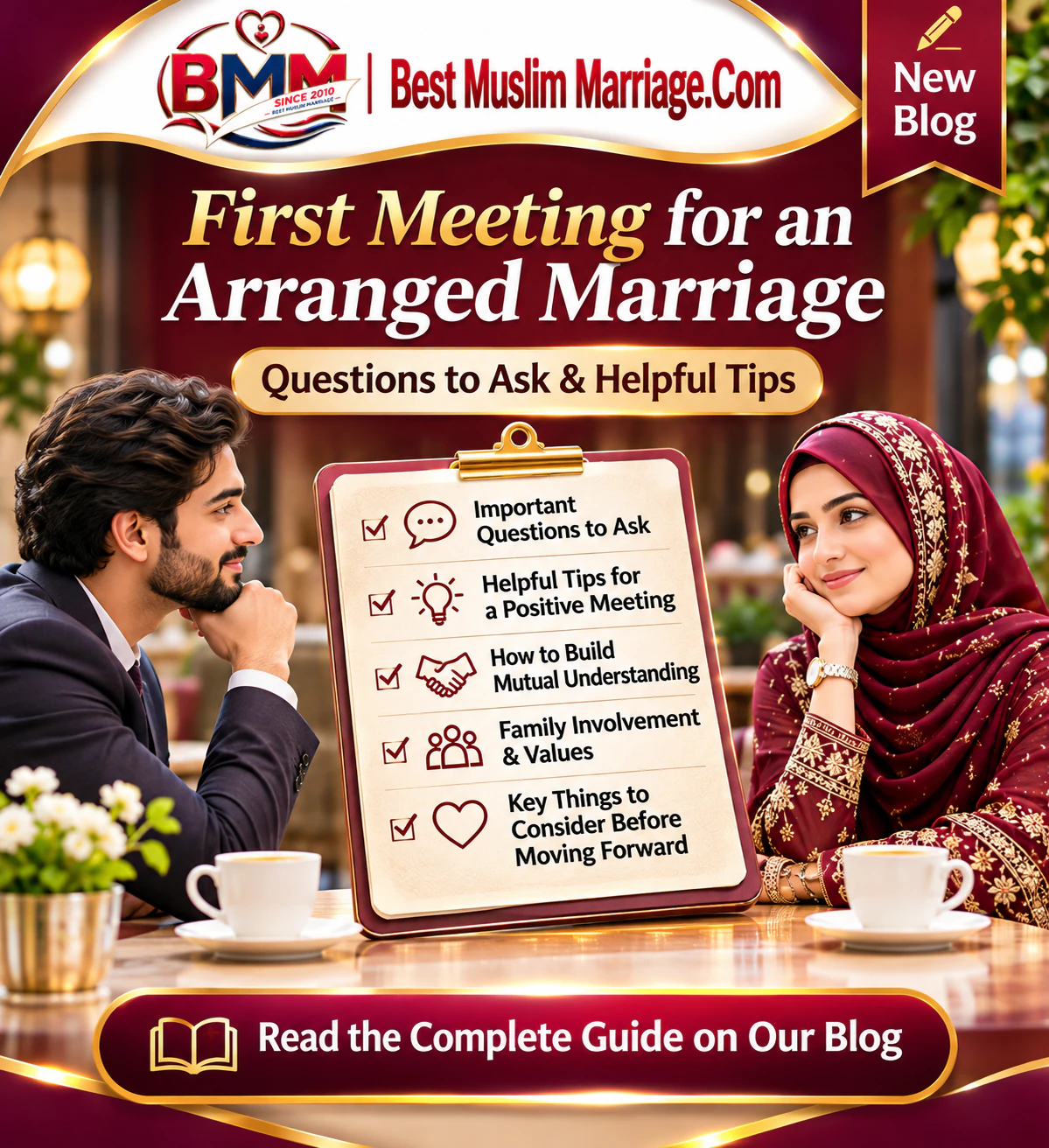
First Meeting for an Arranged Marriage: Questions to Ask and Tips
5 November, 2026
The first meeting is often the moment a proposal becomes real. Until then, both families have only seen a biodata, a few photos and perhaps had a phone call. In an hour or two, the boy, the girl and their families try to get a sense of each other. It is normal to feel nervous. This guide covers how to prepare, which questions to ask in the first meeting for an arranged marriage, what to avoid, and how to decide afterwards.
Before the meeting: a little preparation helps
- Read the biodata again. Note what you already know (education, work, family, city) so you can ask about what is not on paper. If you still need to make yours, see our guide to writing a Muslim marriage biodata.
- Agree on who will attend. A small group, usually parents and one or two close relatives, keeps the meeting relaxed. A large crowd makes honest conversation difficult.
- Choose a calm time and place. Most families meet at home. A weekend afternoon gives everyone time without rushing.
- Talk to your parents beforehand. Tell them what matters most to you, so they don't ask about things you don't care about and skip the ones you do.
- Keep expectations realistic. One meeting is for getting to know each other, not for making a final decision.
How to start the conversation
The first few minutes are usually the hardest. Simple, friendly questions work better than serious ones:
- How was your week? Was it busy at work or college?
- What do you usually do on weekends?
- How did your family find this proposal?
- What do you enjoy most about your work or studies?
Once both of you are comfortable, the more important questions come naturally.
Questions to ask in the first meeting
Daily life and work
- What does a normal day look like for you?
- What are your working hours? Do you travel for work?
- Where do you see your career in the next few years?
Family and living arrangements
- Who lives with you at home, and how close are you to your extended family?
- After marriage, where would we live: with family, separately, or in another city?
- What role do you expect each of us to play at home?
Values and faith
- How do you practise your deen day to day?
- What kind of home and family atmosphere do you want to build?
- Which values from your own family would you like to keep?
Future plans
- Would you be comfortable if your spouse works or continues studying after marriage?
- Are you planning to move to another city or abroad?
- When would you like the Nikah to happen, and what kind of wedding do you prefer, simple or large?
Questions a girl often asks a boy
- Would I be able to keep working or studying after marriage?
- How would decisions be made at home, by us or by the elders?
- How do you handle disagreements?
Questions a boy often asks a girl
- What are you looking for in a life partner?
- How do you feel about living with or near my family?
- What are your plans for your career or studies?
You don't need to ask all of these. Pick the five or six that matter most to you and let the rest come up in later conversations.
What not to ask in the first meeting
- Exact salary or property details in front of everyone. Elders can discuss finances later, privately and respectfully.
- Detailed questions about past relationships. If something important needs to be shared, it is better done honestly at a later stage.
- Dowry or gifts. Any demand for dowry or expensive gifts is a serious red flag. Don't raise it, and be careful if the other side does.
- Comparisons with other proposals. They make the other family uncomfortable and rarely help.
Tips for parents
- Give the boy and girl time to talk. Many families let them speak in the same room or nearby, with family around. Follow what both families are comfortable with.
- Don't turn it into an interview. A few warm questions leave a better impression than a long list.
- Listen more than you speak. You learn a lot about a family from how they treat each other and their guests.
- Don't decide on the spot. Thank the other family, go home, and talk it over calmly.
Signs to notice
Good signs: both people speak openly, the families are respectful to each other, and answers match what was in the biodata. Warning signs: pressure to decide quickly, details that don't match the biodata, avoiding simple questions about work or family, or any demand for money or gifts. For more on spotting warning signs, read our guide on how to identify fake matrimonial profiles.
After the meeting: how to decide
- Take a day or two. Talk about how you felt, not just what was said.
- Write down any open questions. A second meeting or a family phone call can answer them.
- Reply within a reasonable time. Keeping a family waiting for weeks is unkind.
- If the answer is no, say it politely. A short message through the elders or the marriage bureau is enough. There is no need to give detailed reasons.
For a deeper look at what to consider before saying yes, see our checklist for choosing a compatible Muslim partner.
How Best Muslim Marriage helps
Best Muslim Marriage has been a Muslim marriage bureau in BTM Layout, Bangalore, since 2010. We help families find suitable proposals and, when both sides are interested, help coordinate the first conversation and the family meeting. Browse Muslim matrimony in Bangalore or talk to our team.
Register free to start your search.
Frequently asked questions
How long should the first meeting last?
Usually one to two hours is enough. Long enough to talk properly, short enough that nobody feels tired or pressured.
Can the boy and girl talk privately?
Many families allow them to talk in the same room or nearby while the family is around. Agree on this beforehand so everyone is comfortable.
Can the first meeting happen on a video call?
Yes. When one family lives in another city or abroad, a video call with both families present is a good first step, followed by an in-person meeting.
What if we are not sure after one meeting?
That is common. Ask for a second meeting or a phone call between the families before deciding.
Who should reply after the meeting?
Usually the elders reply to each other, or the reply goes through the marriage bureau that introduced the proposal.