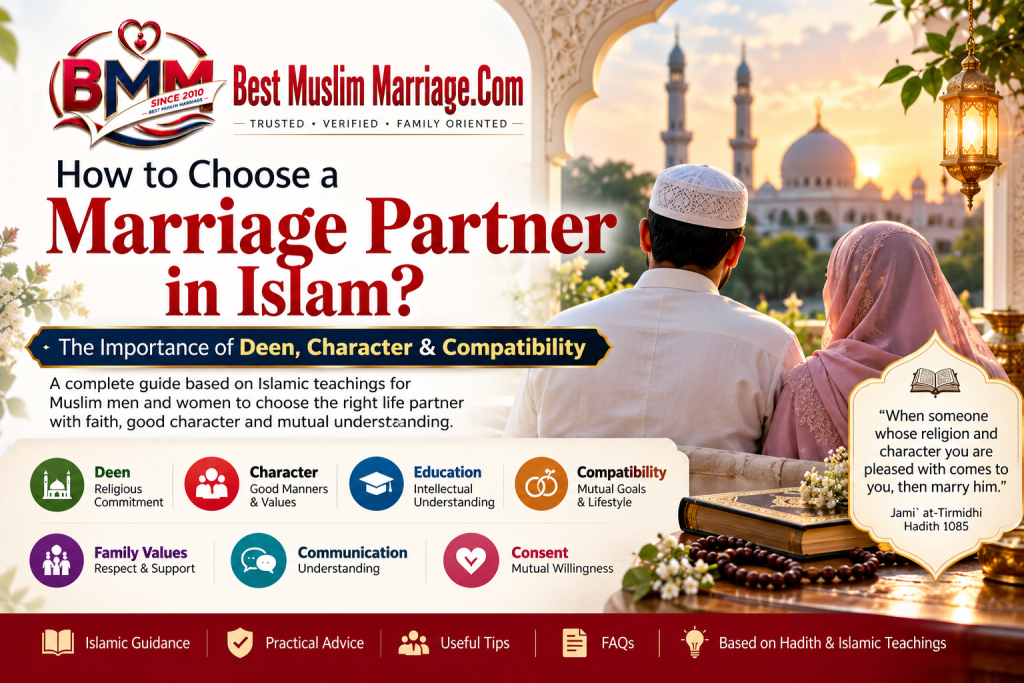
Marriage, or Nikah, is a sacred and important commitment in Islam. Choosing the right life partner is therefore a decision that should be made thoughtfully and responsibly.
Islam does not encourage choosing a spouse based only on beauty, wealth, education, profession, or family status. Along with these considerations, religious commitment (Deen), good character (Akhlaq), mutual understanding, consent, and compatibility are important factors when choosing a suitable marriage partner.
For educated Muslim men and women, compatibility can also include education, lifestyle, career expectations, family values, communication, and future goals. These practical considerations should complement Islamic values rather than replace them.
The Prophet Muhammad ﷺ emphasized the importance of choosing a spouse based on religious commitment.
Abu Hurairah (RA) reported that the Prophet ﷺ said that a woman may be married for her wealth, family status, beauty, or religion, and he encouraged choosing the one who is religious.
Reference: Sahih al-Bukhari, Hadith 5090.
This Hadith highlights the importance of Deen when choosing a wife. Beauty, wealth, and family background may have their place in marriage decisions, but religious commitment should not be overlooked.
Deen is not limited to outward appearance or religious rituals alone. Good character, honesty, modesty, responsibility, trustworthiness, kindness, and respect for the rights of others are also important aspects of a person's character.
When considering a marriage proposal for a daughter, families should look beyond income, profession, appearance, or social status.
They should also consider:
A good education or successful career can be valuable, but these qualities alone do not guarantee a successful marriage. Character, responsibility, religious values, and compatibility matter as well.
Families looking specifically for educated Muslim proposals can explore verified educated Muslim profiles in Bangalore and Karnataka while considering the broader qualities discussed in this guide.
Islam also places importance on religious commitment when choosing a wife.
A Muslim man and his family may consider a woman's
Beauty and education can be considered, but they should not become the only basis for selecting a spouse.
A strong marriage is built on mutual understanding, respect, trust, responsibility, communication, and shared values.
The Prophet Muhammad ﷺ said:
“When someone whose religion and character you are pleased with comes to you, then marry him.”
Reference: Jami` at-Tirmidhi, Hadith 1085.
This Hadith emphasizes the importance of religion and character when considering a man for marriage.
This does not mean that education, financial responsibility, profession, or family circumstances should be ignored. Rather, these practical considerations should be viewed alongside the person's religious commitment and character.
A person's true character becomes especially important in marriage because married life involves responsibilities, disagreements, financial decisions, family relationships, emotional challenges, and mutual rights.
Compatibility means having enough understanding and common ground in important areas of married life to build a stable and respectful relationship.
For educated Muslim men and women, compatibility does not necessarily mean having exactly the same degree, profession, or income.
Compatibility can include:
Two people do not have to be identical to have a successful marriage. However, they should be able to understand, respect, and support each other's important values and life goals.
Families searching for Muslim marriage proposals across the state can also explore Muslim matrimony services in Karnataka and consider compatibility alongside Deen and character.
The concept of Kufu is discussed in Islamic jurisprudence in relation to suitability and compatibility between prospective spouses.
Its detailed legal discussion can vary among Islamic schools of jurisprudence. Therefore, Kufu should not simply be reduced to having the same educational qualification, wealth, or social status.
In the modern Muslim matrimonial context, compatibility may involve religion, character, family circumstances, lifestyle, education, expectations, and the ability of both individuals to build a stable family life together.
For example, an educated woman does not necessarily need to marry a man with exactly the same degree or profession. More important considerations may include whether both individuals respect each other's aspirations, values, responsibilities, and way of life.
Education is an important part of modern marriage decisions. However, having a university degree or professional qualification alone does not determine whether someone will be a good spouse.
A highly educated person may still struggle in marriage if there is a lack of honesty, responsibility, respect, communication, or good character.
Likewise, religious commitment can provide an important foundation for marriage when it is reflected through good manners, responsibility, compassion, and respect.
Therefore, when choosing an educated Muslim spouse, families can consider a balanced combination of:
Deen + Character + Education + Responsibility + Compatibility
For families seeking verified matrimonial proposals, verified Muslim matrimony in Bangalore can be a useful starting point while evaluating individual profiles carefully.
Marriage is a major life decision, and the consent of both the bride and groom should be taken seriously.
Parents and guardians can provide valuable advice, guidance, and support. However, marriage should not be approached as a decision that completely ignores the wishes of the individuals getting married.
Islamic teachings also provide guidance regarding seeing a prospective spouse before marriage within appropriate Islamic boundaries.
Reference: Sunan Ibn Majah, Hadith 1866.
The purpose is to allow prospective spouses to gain reasonable understanding of each other before making an important lifelong commitment.
Consider religious commitment, honesty, manners, responsibility, modesty, and treatment of others.
Education and profession can be considered in relation to family expectations and future plans.
Understand the family environment, expectations, responsibilities, and important circumstances.
Can both individuals communicate respectfully? Can they discuss differences without unnecessary conflict?
Discuss important expectations regarding career, residence, family responsibilities, children, and lifestyle within appropriate boundaries.
Matrimonial profiles may contain information about education, profession, location, marital status, family background, and other personal details.
Important information should be appropriately verified before making a final decision.
Families looking beyond Bangalore can also consider Muslim matrimonial services across India, while independently evaluating each prospective match.
In today's digital age, matrimonial websites and online platforms have made it easier for Muslim families to search for potential marriage partners. However, trust, privacy, and verification are equally important.
A matrimonial profile should not be judged only by photographs or written information. Families should take reasonable steps to verify important details and understand the background of a prospective match before moving forward.
At Best Muslim Marriage.Com, the focus is on helping Muslim families find suitable matrimonial proposals through a personalized and verification-focused matchmaking approach.
The goal is not simply to find a profile, but to help families explore potential matches based on relevant factors such as Deen, character, education, family background, preferences, and compatibility.
Understanding the matchmaking process can also help families know what to expect. Read How Best Muslim Marriage works to learn more about the process.
Choosing a marriage partner does not have to mean choosing between religious values and practical compatibility.
A balanced approach can consider both.
For example, a family may look for a prospective spouse who:
This approach allows families to consider the complete person rather than focusing on just one characteristic.
For Muslim families considering international proposals, the same principles apply. Whether evaluating an Australia Muslim matrimony proposal or a Germany Muslim matrimony profile, Deen, character, compatibility, family expectations, and genuine information should remain important considerations.
Choosing a husband or wife is one of the most important decisions in life.
Islamic teachings emphasize the importance of Deen and good character, while practical considerations such as education, profession, family circumstances, personality, lifestyle, and compatibility can also help families make a thoughtful decision.
A successful Muslim marriage is not based only on a good photograph, high salary, prestigious degree, or family status.
A stronger foundation can be built through:
Deen + Good Character + Mutual Respect + Compatibility + Responsibility + Consent
Families should avoid making rushed decisions and should take reasonable time to understand a prospective spouse, verify important information, seek appropriate family advice, and make dua before moving forward.
For Muslim families looking for suitable marriage proposals in Bangalore and across India, Best Muslim Marriage.Com provides personalized Muslim matrimony and matchmaking assistance focused on meaningful and respectful connections.
Islam gives strong importance to Deen and good character when choosing a spouse. Other factors such as education, family background, profession, and compatibility can also be considered.
Not necessarily. The two individuals do not need to have exactly the same educational qualifications. Mutual understanding, respect, religious values, personality, and compatible life goals can be more important than having identical degrees.
Yes. Beauty, wealth, family background, and other qualities may be considered. However, the Prophet ﷺ emphasized giving importance to religious commitment.
Yes. The genuine willingness of the bride and groom is an important consideration in marriage. Parents and guardians can provide guidance, but marriage should not be treated as a decision that ignores the individuals involved.
Yes. Important information such as education, profession, marital status, family background, and other relevant details should be appropriately verified before making a final decision.
Kufu refers broadly to suitability or compatibility between prospective spouses. Its detailed interpretation is discussed differently within Islamic jurisprudence, so it should not be reduced simply to equal education, wealth, or social status.
A healthy Muslim marriage can be strengthened by Deen, good character, mutual respect, communication, responsibility, trust, compatibility, and a shared commitment to fulfilling the rights and responsibilities of marriage.
9th October, 2026